

Science

Science, technology and the emergence of AI have converged to make precision medicine for acute care a reality. This is how we deliver healthcare tailored to biology.

Research & Development

Evidence

Clinical Trials

The Sepsis ImmunoScore® Predicts Sepsis, Mortality, and Deterioration Better than Clinical Scores and Widely Available Biomarkers

Read More →

Products

Prenosis is developing a pipeline of integrated diagnostics and therapeutics grounded in each patient's unique biological profile, using deep data science and AI to give clinicians tools that reflect the true complexity of critical disease.

Immunix®

Sepsis ImmunoScore®

BioAegis Therapeutics Announces Collaboration with Prenosis to Advance AI-Driven Precision Medicine in Inflammatory Disease

Read More →

Resources

Blogs, articles, videos, and podcasts exploring how precision medicine and AI are changing the way clinicians detect and treat critical conditions.

Resource Library

Events

Treating the Patient, Not the Disease

Read More →

Newsroom

Read the latest Prenosis peer-reviewed articles and items from scholarly journals.

Newsroom

Sepsis ImmunoScore Outperforms Conventional Sepsis Tools

Read More →

About

As a biology-based technology company, we combine data science with AI to transform how critical conditions are diagnosed and treated.

Mission, Vision & Values

Careers

Leadership

Awards

LifeBridge Health deploys Prenosis’ FDA-authorized AI tool to speed sepsis detection

Read More →

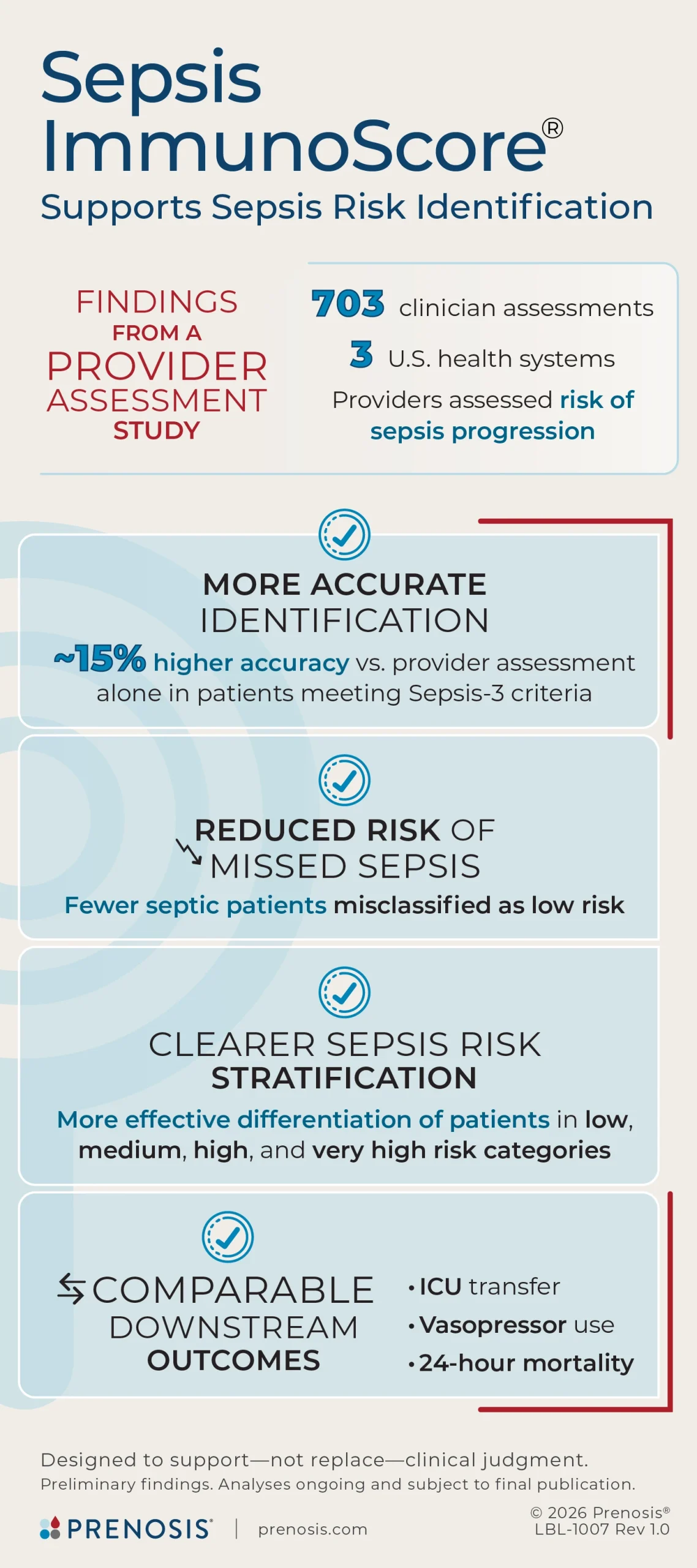
Sepsis ImmunoScore Supports Sepsis Risk Identification

Sepsis ImmunoScore® enhances the accuracy of sepsis risk identification when used alongside clinical judgment.

In a provider study of 703 clinician assessments across 3 U.S. health systems, Sepsis ImmunoScore demonstrated approximately 15% higher accuracy in identifying patients meeting Sepsis-3 criteria compared to provider assessment alone. The study also indicated that the use of Sepsis ImmunoScore reduced the risk of missed sepsis by lowering the rate of septic patients misclassified as low risk, while enabling clearer stratification across low, medium, high, and very high risk categories. Downstream outcomes — including ICU transfer, vasopressor use, and 24-hour mortality — were comparable, underscoring the tool’s role as a meaningful complement to clinical decision-making.